Supporting Noble Causes: Sketches from a Sunlit Heaven has won an International Firebird Book Award!

AUTHORS JOIN THE INTERNATIONAL FIREBIRD BOOK AWARD CIRCLE OF WINNERS

This July 2024 Speak Up Talk Radio announced the recent INTERNATIONAL FIREBIRD BOOK AWARDS contest winners. 

One of the winning entries was from UK author Sarah Law, whose book titled Sketches from a Sunlit Heaven won first place in the Religion – Fiction category.

Authors and publishers worldwide submitted their work to the International Firebird Book Awards. The panel of judges includes 27 individuals with diverse backgrounds and experiences. Two judges from a select panel read and scored each entry. All judges commit to a set of standardized criteria that evaluate the quality of the writing and the production aspects. The judges only award the coveted Firebird to entries with the highest scores.

Authors can view their entry fee for the International Firebird Book Awards as more than just a fee. It’s a tax-deductible donation that supports a noble cause. Patricia J. Rullo, the awards’ founder, explains, “We give back by hand making colorful pillowcases. We send them, along with children’s books, to women and children who are experiencing homelessness. This includes the shelter Enchanted Makeovers, which is a tax-exempt organization. In this way, authors gain recognition for their work and play a significant role in transforming homeless shelters into bright homes. Winning a book award feels good, but knowing your participation makes a difference feels even better.”

“Speak Up Talk Radio is a gateway to multiple avenues for creative individuals to promote themselves. We provide various opportunities for authors and podcasters to showcase their work and connect with their audience. This includes book awards, podcast awards, radio interviews, audiobook production, podcasting services, social media and audio marketing, and book editing and formatting services.”

The International Firebird Book Awards run quarterly contests so authors can receive timely recognition. Authors of all genres, mainstream, independent, and self-published, are welcome. For additional winning authors, titles, and entry information:

Double Win at 2024 International Book Awards: Fiction and Poetry Categories

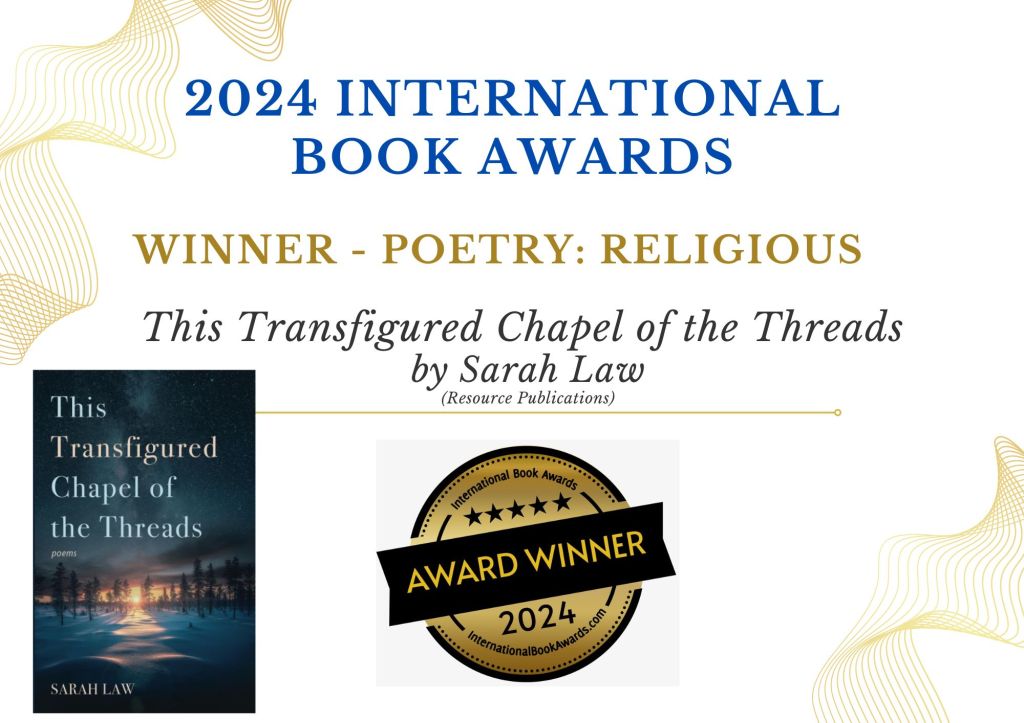
I’m delighted to say that my novel Sketches from a Sunlit Heaven has won the Fiction: Religious category at this year’s International Book Awards… and my latest poetry collection, This Transfigured Chapel of the Threads has also won – in the category of Poetry: Religious.

Read the Press Release Here. Congratulations to all award winners and finalists.

This means the world to me, as the IBAs are internationally respected and honour both indie and mainstream publications. I’m celebrating this double win on what is almost the longest day of the year with several hours of evening sunshine!

Celine’s Spiritual Desolation: A Moving Encounter in an Abandoned Church (unpublished novel extract)

I did want to include this section in my novel, but I couldn’t find the right place for it in the overall narrative. In this section, Celine feels herself desolate and abandoned while three of her sisters pursue religious life, and she is unable to share her feelings with Leonie, her only other sister in the world. She finds a neglected country church, and in it what Celine perceives as a neglected and uncared for reserved sacrament. She is able, in her distress, to identify with its apparent neglect. This section is based, as many of my sections were, on some elements of correspondence between the Martin sisters.

I’m missing Jeanne [Adele in my final m/s]. Her wit, her practicality. Her wide-eyed stare belies the thoroughly grounded soul. And to marry: that ultimate vow of human love, the one to the other. Just as Mama and Papa were, all those years ago, before their bouquet of the living and the dead pushed through Mama’s fertile, finite flesh. 

Here at La Musse without Francis and Jeanne I am left with Leonie and Lucie [her younger cousin]. Leonie, poor pinched sister, is my shadow, except for the evenings when I retire to my room and assume she does likewise. We do not converse on the fabric of heaven the way I used to with Therese. 

Lucie is very young when measured against we two semi-orphans. It is not just the lack of years compared with us, though this is a fact. She is silly-young in a way Therese rarely, if ever was. She teases and doesn’t sense the incipient hurt feelings of others. See how she made fun of Leonie in a pose for the photograph yesterday, extending a paintbrush to mock-poke the back of Leonie’s head and distress the symmetry of our double portrait. 

And yet, there is a bright grace in her. One day she will see it in herself and be astonished.

Leonie and I walk in the country streets in the middle of the hot afternoon. July is a month of glory and unremitting glare. We see a small church, removed from the dirt track of a road down which we stroll, hotly, despondently. It is a church without a name. ‘Let’s go in, Leonie,’ I suggest. ‘It’s a hot afternoon, but I’m not ready to return to La Musse yet. Uncle and Aunt will be resting, and it’s too depressing to sit in those empty rooms, awaiting yet more coffee.’ Leonie offers me her characteristic squint and tight lipped smile. She nods, agreeing. ‘I have never excelled at politeness,’ she offers, after a pause. ‘And after two weeks at La Musse, I have exhausted the little talent I have for it.’ She turns, as I have done, to face the church. I link my arm with hers – we are both wearing white muslin full length sleeves under our tightly buttoned bodies – and we approach this little echo of what we hold most dear. 

The door creaks open; it is thick dark wood which has swollen in the heat, like our own feet and hands. I go in. Leonie follows. Motes of dust shimmer in the air which is sliced through by coloured light; narrow windows either side of the stone font provide this illumination, which is short lived as we proceed down the aisle. To the right, an uncared for statue of the Virgin. Leonie settles there and reaches in her little handbag for her rosary. I move to the front of the church where the altar is in shadows. I feel strongly that Jesus is here, and I search for the reserved sacrament. I spy him, and am distraught at the discovery.

I have found God in a poor cup.

The little ciborium rests in its recess; it lacks not only a sanctuary lamp but any light at all. Spiders and the dust of neglect could nestle there, undetected and undisturbed. I am struck by a pain in my head and my heart, and move to kneel on the unswept stone of the sanctuary floor. Is it possible? Does Jesus live on in such a place? I cannot resist, I get to my feet again and approach the small recess, shelf-high. What looks like a rag rests over the tarnished goblet. Crossing myself first, I reach out my right hand and lift the stained little cloth. A single dry host in the bottom of the cup. A pressure squeezes my chest and I can’t help myself, ‘Oh, my God!’ I say. And then I back away, step down into the poor floor of the church and sit down shakily on a wooden chair, in front of this abandoned divinity. Leonie, I assume, is repeating her Ave Marias, pacing securely through them with the aid of the beads; a tightrope walker with a safe harness. But though I am now seated, I am in free fall.

The pulse, the spark of the world, guttering out here in this lonely place. Is it possible? That God should be so discarded in a Catholic nation? I experience a terrible ripping sensation in the pit of my stomach. What is reality, what truth? I am Celine, twenty-one years old, a woman in silk dresses, gold jewellery, who lives on in the world for the sake of her father. My future is a blank canvass stained with God and duty. A bit of cloth to be blown away. My soul a dried sliver of driftwood. Is any of it real? Reality: the real presence. The presence of He who made the universe, then entered it to die, here in this poor stable of a temple. I blink to clear the sting of tears, and between blinks the whole thing vanishes: there is no heaven, no earth, no God, no Celine, no Therese. Only an empty chair on a cold stone floor, for the loveless void of eternity. What is the point of a beating heart? 

I blink again. And the old yearning structure of my childhood resumes its place, a fractured skeleton caging Celine’s soul. There is God and Jesus. Death is a return to the Fatherland, where Mother and four little children await me. Life passes in daubs of light and arcs of thunderous grey. I am mother to an aged man who babbles and bawls like an infant. My Therese, who has flown to the only safe ark in the world, is right: there is nothing to do but love. And here is love poorly acknowledged. To dwell at La Musse, with its rambling gardens, its stairwells and chambers, its parties and soirees: and all the time here in lost shadow is God. This poor place. The priests here are old, they have spent what lifeblood they possessed decades ago. I doubt Mass is said here from Easter to Easter. I understand how in poverty, requirements of the body seem greater than those of the soul. But still, to have a God, who entrusts himself in such simplicity, shunned in this way affects me deeply. I close my eyes. I breathe with concentration, offering each round of breath as salve for the lonely of the world. 

Poor Christ. And though I am feted in the plush, confined world of the Guerins while He languishes here, in another way I sense my deep affinity with Him. My three Carmelite sisters live in consecrated purity. Leonie – who knows the movements of Leonie’s soul. But she says she want to go to the Visitation, and has already shown her stubborn disregard of others when it comes to following a perceived vocation. It is only I who remain in my dusty spiritual corner, unrecognized; unable to come out. This is not the affinity I long for. And yet it is where I am placed; for this momentary lifetime. For this Year of Our Lord. 

Teaching Catholic Literature: Engage Students with ‘Sketches from a Sunlit Heaven’

Here are five reasons for including or adopting my novel in your Creative Writing or Literature class – especially if you are teaching or introducing Catholic Literature/ The Catholic Literary Imagination

Sketches from a Sunlit Heaven by Sarah Law, Wipf and Stock, 2022

Subject Matter. This novel is about the life and legacy of a much-loved saint, Therese of Lisieux, who lived from 1873 to 1897 in Normandy, France, and, for the last nine years of her life was a Carmelite nun in a monastery of Lisieux.  Therese is a saint whose brief life and ostensibly simple teaching has wide and enduring appeal.  She catches at the hearts of so many different people, including French chanteuse Edith Piaf. She was proclaimed a Doctor of the Church in 1997 and her teachings are present in the Catechism of the Catholic Church. Her spiritual insights point to a loving and merciful god in whom we may have confidence, and for whom the smallest deed can be an offering of love. Pope Pius X described her as ‘the greatest saint of modern times.’ Significantly, the centenary of her canonisation falls in 2025.  My novel, for which I undertook years of immersive research, can help set the scene for new students to meet this wonderfully approachable saint.

Historical context and span. My novel spans a wide stretch of history, from 1870 to 1958. Cultural and political shifts and international conflicts during this period were immense, including two World Wars, the first of which saw huge numbers of the faithful turn to Therese in prayer, and the second of which saw the bombing of Lisieux and the dramatic temporary exodus of the Carmelite monastery which was still home to two of Therese’s blood sisters. Cultural shifts included the rise of photography and new depictions of the sacred in art and literature. My novel is aware of these issues and many others, while remaining faithful to the world of enclosed religious communities.

Literary elements. I am an academic, editor, and published essayist and poet as well as the author of Sketches. I made conscious and informed choices about the structure, voices and style of my novel, about which I speak in my novel’s introduction and a number of published reviews and essays. For example, my choice of a polyphonic narration, inspired by Woof’s The Waves and a range of other works, is a central structural device. My use of sustained image complexes and of character flaws and stories were carefully worked through ad equally conscious choices. My novel’s introduction refers to other fictional depictions of Therese (including those by Ron Hansen and Michelle Roberts) which provide contemporary context. In addition, I have published two poetry collections exploring Therese’s life and legacy. I believe that she can be a touchstone for student readers and student writers. 

Academic experience. I have over twenty years of experience teaching both creative writing and English literature in Higher Education and to open access groups, and would be delighted to give talks, tutorials, readings and workshops online or in person from the angle of literary study or creative practice. I’d also be happy to provide provisional teaching plans and prompts – with suggested extracts and recommended further reading – for reading and writing about Sketches. For example: using historical resources and artistic license; dramatizing scenes and creating voice; writing the world of enclosed religious communities (linking with other texts); European Catholicism as it enters the twentieth century; choosing fictional approaches (such as point of view, tense, motifs and themes) and reviewing the writing process from first drafts to final revisions. 

Endorsements and ResourcesSketches from a Sunlit Heaven was awarded the silver medal (Catholic) in the 2023 Illumination Book Awards, and was shortlisted for the 2024 Hawthorne Prize (an elite prize for fiction).  It has been generously received by real-life Carmelite communities and was a ‘Terrific Book Tuesday’ choice for Carmelite Spirit in 2023. An article on my creative and literary choices is available at the Open University, and a more extensive interview on Word on Fire’s Evangelisation and Culture blog (with Thomas Salerno). 

  • From Jamie Michele’s review of Sketches (Reader’s Favourite).

An editorial review of Sketches from a Sunlit Heaven

A concise, insightful review of my novel is up at Literary Titan. I was curious to know what an informed reviewer might make of Sketches. This was uplifting and affirming to receive. Five stars too!

‘Sarah Law’s Sketches from a Sunlit Heaven offers a multifaceted glimpse into the life of Saint Thérèse of Lisieux, a French Carmelite nun who died in 1897 at the age of 24. This historical fiction is uniquely structured, narrated through the distinct voices of six characters—four sisters, one cousin, and a correspondent—who were close to Thérèse in her final years. These perspectives span several decades, from their youthful days to old age, marking the passage of time against the backdrop of two world wars and significant societal changes.

The novel employs a first-person narrative for each protagonist, presenting their stories in the present tense, which imbues the historical narrative with an immediate and compelling quality. This stylistic choice, while unusual, adds a vivid sense of unfolding drama to the narrative. Each character is richly drawn, with distinct voices that reflect their unique responses to life’s joys and hardships. As an artist, I found a particular resonance with Céline, whose passion for painting mirrors my own. The poetic language throughout the book enhances its atmospheric quality, leaving a lasting impression with beautifully crafted phrases such as “I see her as a timeless portrait, her pale face swathed in her white veil.” 

The novel’s dynamic structure, which alternates between characters’ viewpoints, offers brief yet insightful glimpses into each protagonist’s life before transitioning to the next. This approach invites readers to engage deeply, piecing together the rich tapestry of experiences and perspectives that form the heart of the narrative. While it demands attentiveness, this method enriches the storytelling by providing a varied and comprehensive portrayal of the characters’ interconnected lives. Law weaves a tapestry of themes—illness, sin, Catholicism, prayer, love, war, loss, friendship, and family—against a convincingly depicted historical backdrop. The portrayal of letter writing and the impact of war is particularly effective in grounding the story in its period.

For those who appreciate historical fiction with a religious dimension and for readers drawn to emotionally charged, lyrical writing, Sketches from a Sunlit Heaven offers a memorable exploration of human resilience and the enduring power of memory. The novel’s unique structure and evocative prose are sure to leave a resounding impact.’

Read the original here